Branding · Brand identity
Brand identity design for small business. People recognize you.
Brandtropic is a remote branding agency for small businesses in the United States and Canada. We design your brand identity — logo system, color, type, guidelines and first applications — plus naming, positioning and packaging when you need them. A brand usually takes three to five weeks, and you own every source file.
- What it is
- Logo system, color and type, guidelines and the first pieces your business uses.
- Best for
- Businesses starting from zero — or with a logo they’re embarrassed to send.
- Timeline
- Usually 3 to 5 weeks. Strategy and naming set the pace.
- Pricing
- Quoted in three tiers — Basic, Mid and Heavy. US clients invoiced in USD.
- Where
- Remote across the US and Canada, on Pacific Time.
What a brand identity includes
A brand is not a logo file. It is the system that makes every piece — a post, a proposal, a box on a shelf — look like the same company. This is what you get.
- Logo systemA primary logo, a compact version and an icon that still reads at favicon size. Delivered in every format you’ll need, for screen and for print.
- Color systemA palette where every color has a job: what leads, what supports, what signals an action. With the codes for screen and print.
- Type systemTypefaces for headlines and text, and the rules for sizes and spacing. Fonts are licensed to your name where the license allows it.
- Brand guidelinesThe rules to apply all of it, written so anyone — your team, a printer, a new freelancer — can follow them without calling us.
- First applicationsSocial profiles, a presentation, an email signature and the pieces your business actually uses. The brand starts working the week it’s delivered.
- Your source filesEvery source file and every export, yours to keep. Nothing stays hostage.
Before the logo: naming and positioning
The strategy and naming stage is what moves the timeline, not the design. It is also where most of the value sits.
Positioning: why your price makes sense
If your competition looks more expensive than you — and charges more — the problem is rarely the logo. Positioning decides who the brand is for, what it promises and what it refuses to be. Done right, your price stops being the problem.
Messaging that lands in five seconds
If you still can’t explain what you do in one sentence, nobody else can either. We write the line that does it — the one on your homepage, your bio and your first slide — plus a short list of what the brand always says and never says.
Naming
Starting a business or renaming one? We propose names with the reasoning behind each one: how it sounds out loud, how it looks as a logo, how it sits next to your competitors. Before you print anything, have a trademark attorney confirm the name is available where you sell.
Packaging that sells on the shelf
“My packaging looks great on screen and disappears on the shelf.” Packaging is designed for the three seconds someone gives it under store lights, not for the mockup.
A shelf is a crowded, badly lit place where every product shouts the same word. Packaging design starts there: what someone sees from across the aisle, what they read once it’s in their hand, and what makes it go in the basket.
We design the label system, the gift format and the retail pieces around them — shelf-talkers, displays, a trade presentation — so the product and the brand tell one story. For a product line, the system is built so a new flavor or edition can be added later without redrawing everything.
For Los Espíritus, three Caribbean rums with no brand, that meant one glass silhouette for the whole collection and a gold finish on the label that only catches the light near a flame. A retail decision before a romantic one.
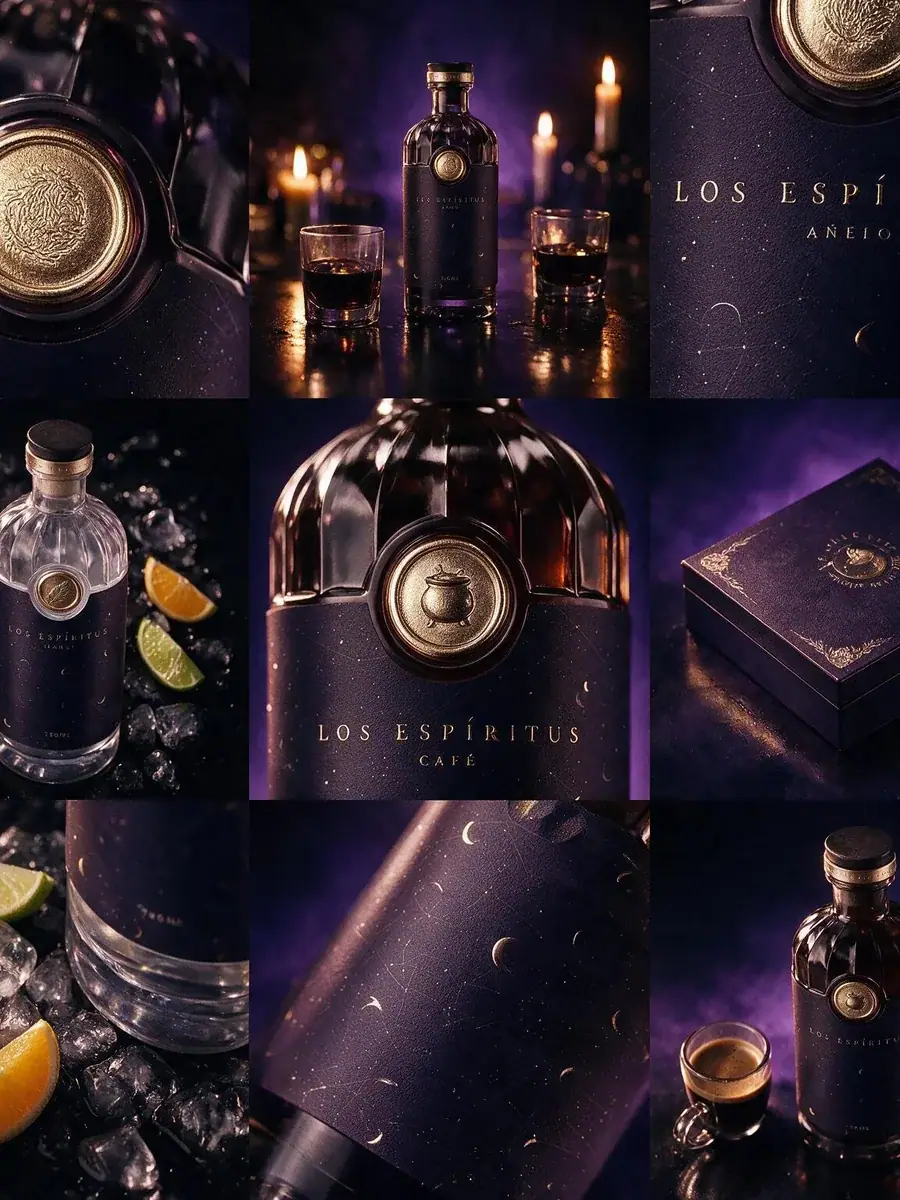
Retail · Packaging + e-commerce
Los Espíritus
Three Caribbean rums packaged as a ritual, sold as a collection: identity, label system, gift box, online store and the social language around them.
Read the case studyHow a brand gets built
Four steps, usually three to five weeks. You see direction before we build, and nothing ships until a person approves it.
Strategy
Half an hour on your business, your customers and your competition. Then positioning, messaging and naming, if you need them.
You approve the strategyDirection
Visual routes shown before anything is built. If the first route isn’t right, we say so early and take another one.
You pick the routeThe system
Logo, color, type and first applications, built from the chosen route. AI speeds up production; a designer decides every detail.
Rounds agreed up frontGuidelines and handover
The rules document, every source file and every export. Your brand is ready for the website, the shelf and the feed.
You own the files
You own every file
When the project closes, the brand is yours: source files, every export, and fonts licensed to your name where the license allows it. Take them to any printer, developer or agency you like.
That also means guidelines written for people who aren’t us. If your brand looks like a different company on every platform today, the fix is one identity system and rules anyone can follow.
No surprises at the end
Revision rounds are agreed in the proposal, not improvised on the last day, so you know how many there are and what each one covers. Brand is a project with a closing date.
When you’re ready to grow from it, the next step is a website built to be found — one that shows up on Google and that AI assistants like ChatGPT can recommend, through SEO, AEO and GEO.
How much does branding cost?
Anywhere from free to $50,000 and up. The useful answer depends on what the brand has to carry.
We don’t publish fixed prices, because a one-person studio and a product line on retail shelves don’t need the same brand. Every brand is sized to your case in three tiers — Basic, Mid and Heavy — and you get a clear proposal before you commit: what we’ll do, what it costs and how long it takes.
What moves the number: whether you need naming and positioning, how many applications the brand has to cover, packaging, and how many rounds you want. For reference, this is what the US market charges:
| Option | Typical range | What you usually get |
|---|---|---|
| DIY tools | Free to a few hundred dollars | A logo from a template or a logo maker; the rules are up to you |
| Freelance designer | A few hundred to a few thousand dollars | One person’s work; scope and guidelines vary widely |
| Small studio or agency | About $5,000–$30,000 | Strategy, a full identity system and guidelines from a team |
| Large agency | $50,000 and up | Research-heavy programs built for large organizations |
| Brandtropic | Quoted in three tiers: Basic, Mid and Heavy | Strategy, identity system, guidelines and first applications, sized to your case |
Ranges are indicative market figures, not Brandtropic prices. Canadian providers usually quote in CAD. US clients are invoiced in USD; Canadian businesses, see how we work with Canada.
Questions about branding
Straight answers, no runaround.
What does a brand identity include?
A logo system in every format you’ll need, a color and type system, and a guideline document with the rules to apply them. Plus the first applications: social profiles, a presentation, an email signature and the pieces your business actually uses day to day.
How long does branding take for a small business?
Usually three to five weeks, depending on how many rounds and applications you need. The strategy and naming stage is what moves the timeline, not the design itself. Packaging adds its own steps, and we put them in the proposal.
How much does branding cost?
We don’t publish fixed prices. Each brand is quoted in three tiers — Basic, Mid and Heavy — with a clear proposal before you commit. For reference, the US market runs from free DIY tools to $50,000 and up at large agencies, with small studios around $5,000 to $30,000.
Who owns the logo and the files when the project ends?
You do. Source files, fonts licensed to your name where the license allows it, and every export you need. You can take them to any printer, developer or agency. Nothing stays hostage.
Can you help with naming and positioning?
Yes. When the business needs it, naming and positioning come before the logo: who the brand is for, what it promises and the one sentence that explains it. Before you print anything, have a trademark attorney confirm the name is available where you sell.
I already have a website. Can you do only the brand?
Yes. We’ll tell you honestly whether the site holds up with the new identity, and what it would cost to align it — but you decide.
What if I don’t like the first direction?
We show direction before we build. If the first route isn’t right, we say so early and take another one. Rounds are agreed in the proposal, not improvised at the end.
Start with the brand. Grow from there.
Tell us where your business is. We reply with a first read of your case and a clear proposal — what we’ll do, what it costs and how long it takes. No commitment.